Blushing Rosette
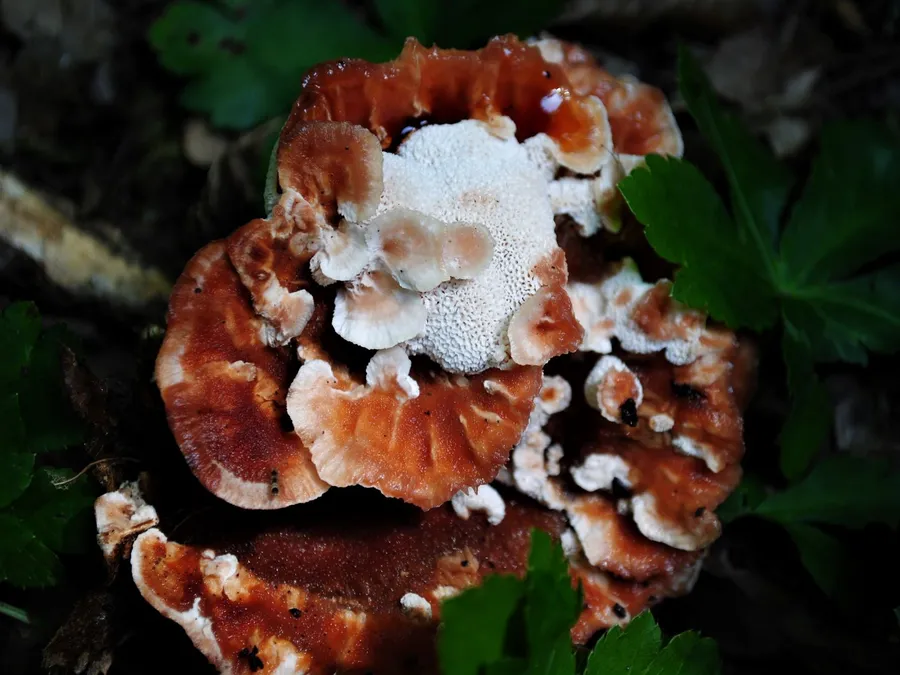


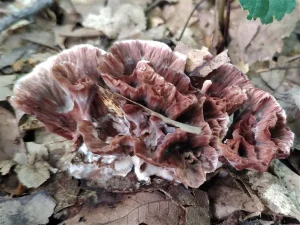
A beautiful, wide-pored annual polypore with a varied appearance. Its most common form is the rosette form, but it has many different irregular forms, including an upside-down, hemispherical form too.
Scientific Name – Abortiporus biennis


Common Names:
Blushing Rosette (EN), Aborted Polypore (US), Roséd Gwridog (CY), Różnoporek Dwuwarstwowy (PL), Rőt Likacsosgomba (HU)
Fruiting Body
Often forms irregular fruit bodies, the below mentioned description describes the regular, rosette form of the species.
Cap 5–20 cm across, nearly flat, roundish to rosette-like, turns irregularly lobe with age; nearby fruit bodies often fused together. Its upper, sterile surface is initially white to off-white, then pink to reddish brown; smooth to slightly hairy (tomentose). Margin thin and paler than the rest of the upper surface, bruising reddish brown when handled or damaged.
Stem 4–7 cm long and 2–3 cm thick, tapering towards the base, often deeply ‘rooting’.
Pores
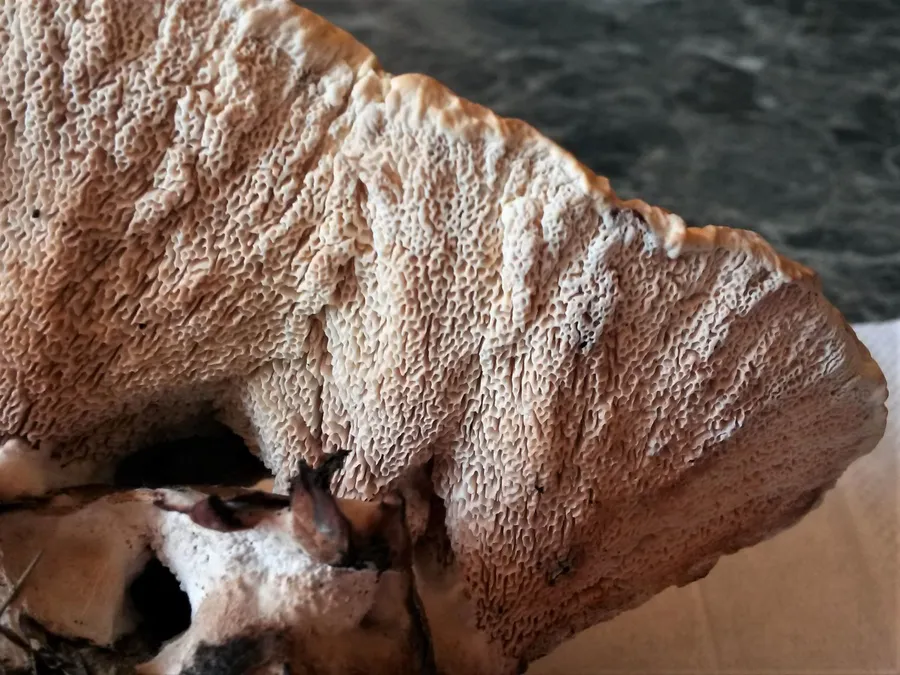
Tubes 5–6 mm long, creamy white. Pores 1–3 per mm (sometimes even wider), irregularly angular to daedaleoid, slightly decurrent; white, staining pink to reddish if damaged.

Flesh
Dual-layered (duplex), 8–10 mm thick. The upper (external) layer is soft and ochraceous, while the core or inner layer is a bit harder (corky) and more cream in colour.

Habitat
On all kind of hardwood, often on buried roots, more rarely on conifers. Saprotrophic, causes white-rot, most of all in the roots of deciduous trees. Growing solitary or in smaller groups. Its main fruiting season is Late Summer to Autumn, but it can be found during the whole year.

Possible Confusion
Young, irregular fruit bodies secrete/oozing red droplets. In this form it can be confused with Devil’s Tooth (Hydnellum peckii) and/or Mealy Tooth (Hydnellum ferrugineum), but both species can be found exclusively in old conifer forests, near Pine or Spruce, also these species have spines (teeth), not wide pores.
The regular fruit bodies might be confused with the rarer Zoned Rosette (Podoscypha multizonata), pictured, which also prefers hardwoods, especially Oaks, but Zoned Rosette doesn’t have visible pores. If we look it more carefully it more reminds of a pink to red stained Wood Cauliflower (Sparassis crispa) than a Blushing Rosette.
Other Facts
It often forms irregular, aberrant fruit bodies. It could be hemispherical with its pores upside-down, but even if it forms its regular, rosette form, the so-called ‘rosecomb mutation’ is rather common. In mycology, the term ‘rosecomb mutation’ is used when any kind of distortions, lumps or malformations occur on the cap and makes visible the gills or the pores.
Its epithet (the 2nd part of the scientific name which identifies the species within the genus) – biennis – suggests it is biennial, but it is incorrect, and likely based on the really variable appearance of this species.