Collared Earthstar
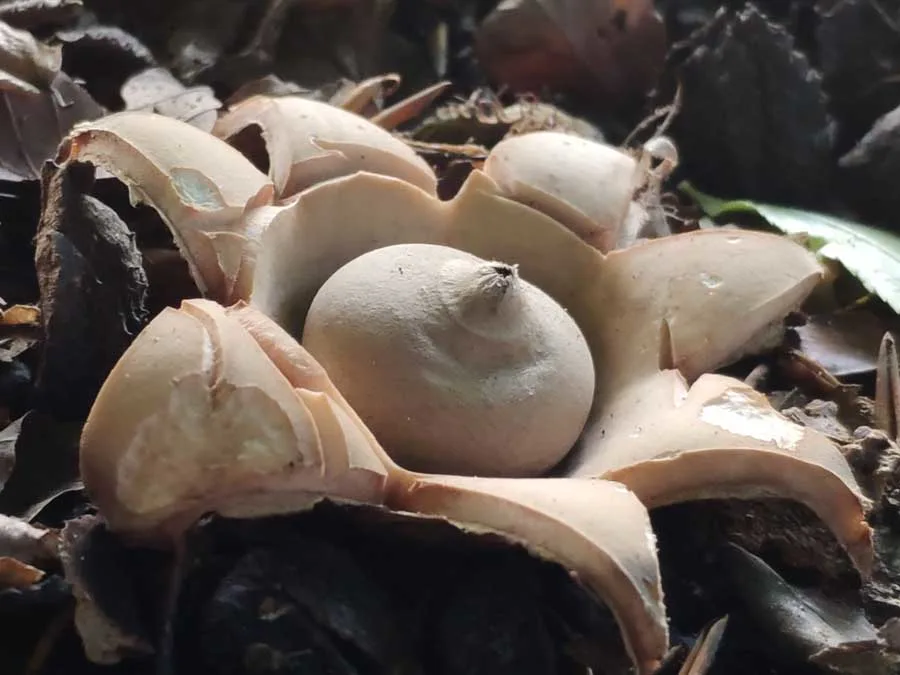


Geastrum triplex is a species of fungus commonly known as the collared earthstar, the saucered earthstar, or the triple earthstar—and less commonly by the alternative species name Geastrum indicum.
Scientific Name – Geastrum michelianum


Common Names:
Collared Earthstar (EN), Saucered Earthstar, Triple Earthstar, Seren Ddaear Dorchog (CY), Gwiazdosz Potrójny (PL), Hármas Csillaggomba (HU)
Please note that each and every mushroom you come across may vary in appearance to these photos.

Fruiting Body
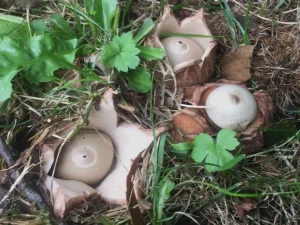
Unlike most of the Earthstars, it starts as an onion-shaped (mostly spherical with a small, round nodule on top) closed sac (2–4 cm in diameter) above the soil surface, and eventually opens up.
The ‘head’ or spore sac (endoperidium) is more or less spherical, thin-walled, greyish brown and smooth. It is sitting on the inner surface of the arms (exoperidium) without having any visible supportive stem-like structure (sessile).
Spore exit (peristom) is raised-conical, fibrous without ridges, and surrounded by a small boundary-halo. Often covered with brown spore powder.
Spore-bearing tissue of the ‘head’, called the ‘gleba‘ is creamy and solid (cheese-like) when immature, powdery and brown when the spores matured.
Outer layer (exoperidium) cracks up to 5–8 arms. The inner surface of the arms brake off and form a saucer or collar-like structure (hence the common English name). It is more or less creamy in the inside, darker brownish on the outside. The arms bend round underneath the fruitbody and lift it up from the soil.

Habitat
Grows on nutrient rich soil, both under deciduous and coniferous trees, preferably on slopes, much less likely on flat areas. Saprotrophic.
Possible Confusion
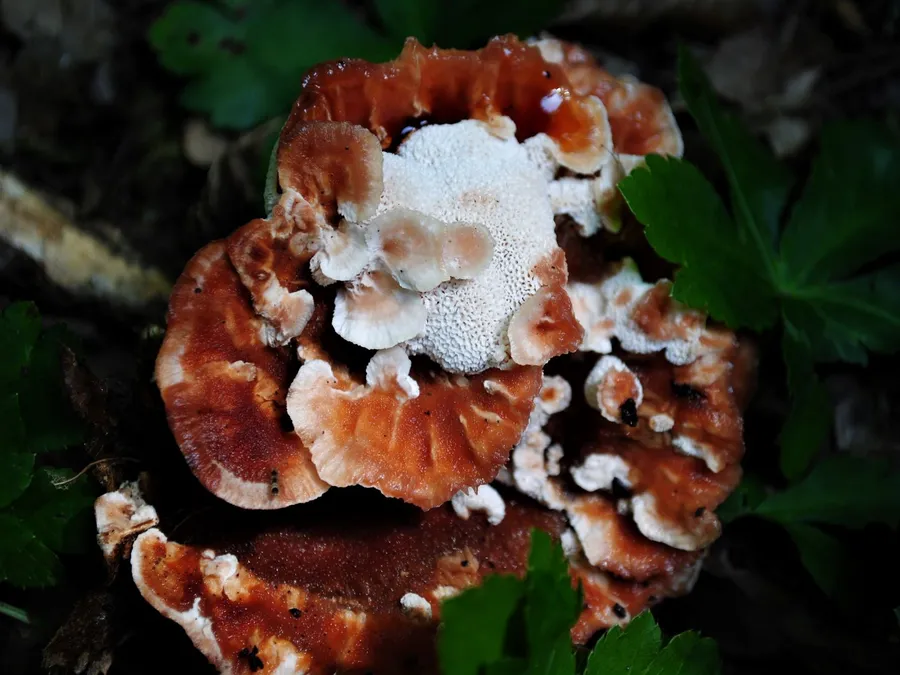
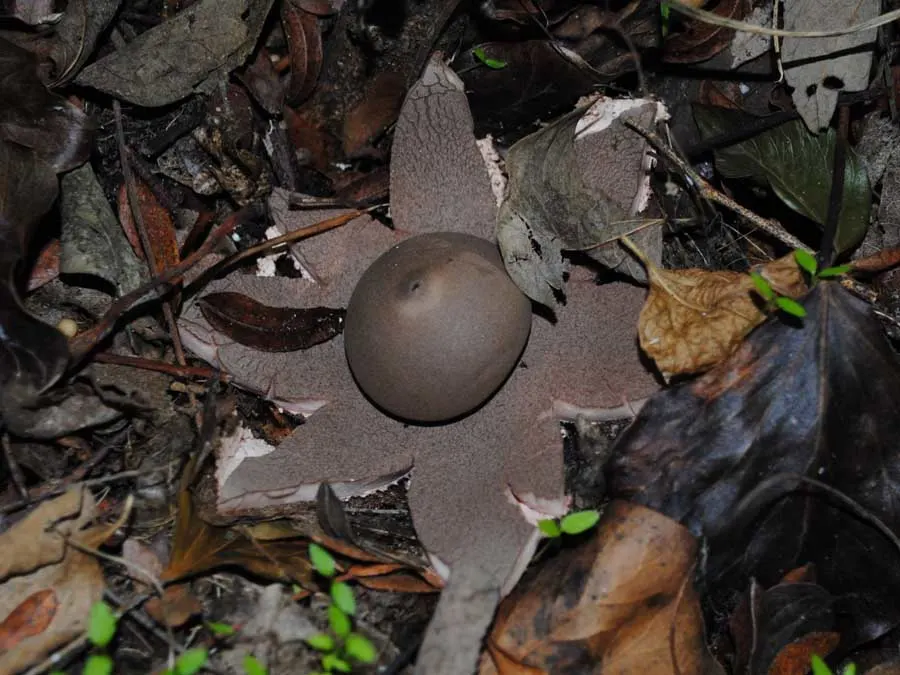
It can be confused with other Earthstars, such as Rufous Earthstar (Geastrum rufescens), pictured, Geastrum saccatum, or Sessile Earthstar (Geastrum fimbriatum), especially if we found an immature (unopened) fruit body.
The peristom of Rufous Earthstar (Geastrum rufescens, pictured) doesn’t have a boundary-halo, and when its arms crack, they are reddening in the cracks.
Geastrum saccatum is much smaller than the Collared Earthstar (Geastrum michelianum), about half of its size, and its arms rather flatten on the soil than crawling under and lift up the fruit body. In a recent phylogeny study by Zamora JC et al (2014) proved that G. michelianum and G. saccatum are two different species from two different sections of genus Geastrum.
The peristom of Sessile Earthstar (Geastrum fimbriatum) doesn’t have a boundary-halo, also, the inner layer of its arms doesn’t brake off and form a collar, not to mention that it is smaller than the Collared Earthstar (Geastrum michelianum).
Other Facts
The scientific name of the genus comes from ancient Greek, where ‘geo‘ means Earth, ‘aster‘ means Star. The epithet (2nd part of the scientific name) refers to the mostly visible three layers of the mature fruit body: the spherical head or spore sac (endoperidium), the broken off inner layer of the arms, and the arms (exoperidium).
Until recently it was called as Geastrum triplex, however, the original Geastrum triplex was described from a Tropical deciduous forest on Java, Indonesia, and has a different DNA to our European Geastrum “triplex“, so we tend to use its former name, Geastrum michelianum, which – in our opinion – should be the valid scientific name of the European species.