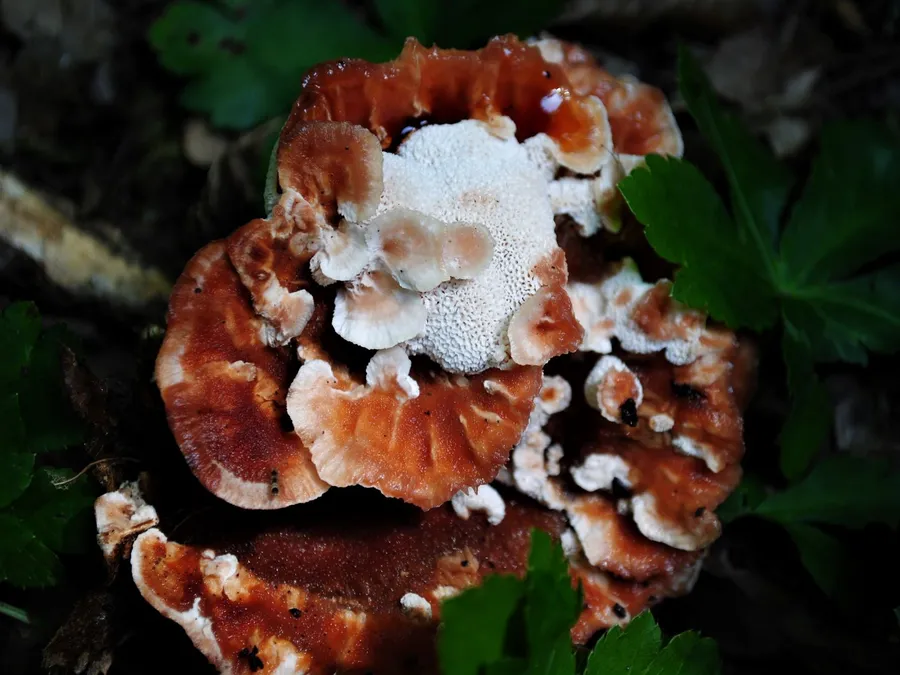
False Chanterelle


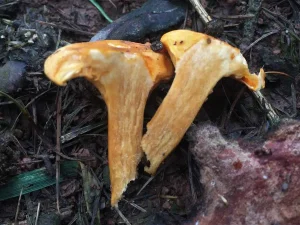
Not strictly speaking a poisonous mushroom but they can cause alarming symptoms in some people. The False Chanterelle (Hygrophoropsis aurantiaca) is a very common and strikingly colourful mushroom, predominantly found in small to large groups, mainly in coniferous woodland.
Scientific Name – Hygrophoropsis aurantiaca

Common Names:
False Chanterelle (EN), Siantrel Ffug (CY), Lisówka Pomarańczowa (PL), Narancsvörös Álrókagomba (HU)
Please note that each and every mushroom you come across may vary in appearance to these photos.

Cap
3-8 cm. Yellow, yellow/orange/brown. Starting convex becoming shallowly funnel shaped with an in-rolled, undulating margin.

Gills
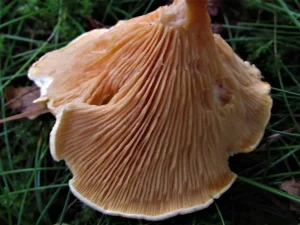
Gills orange. Running down the stem (decurrent), forked many times and crowded.

Stem
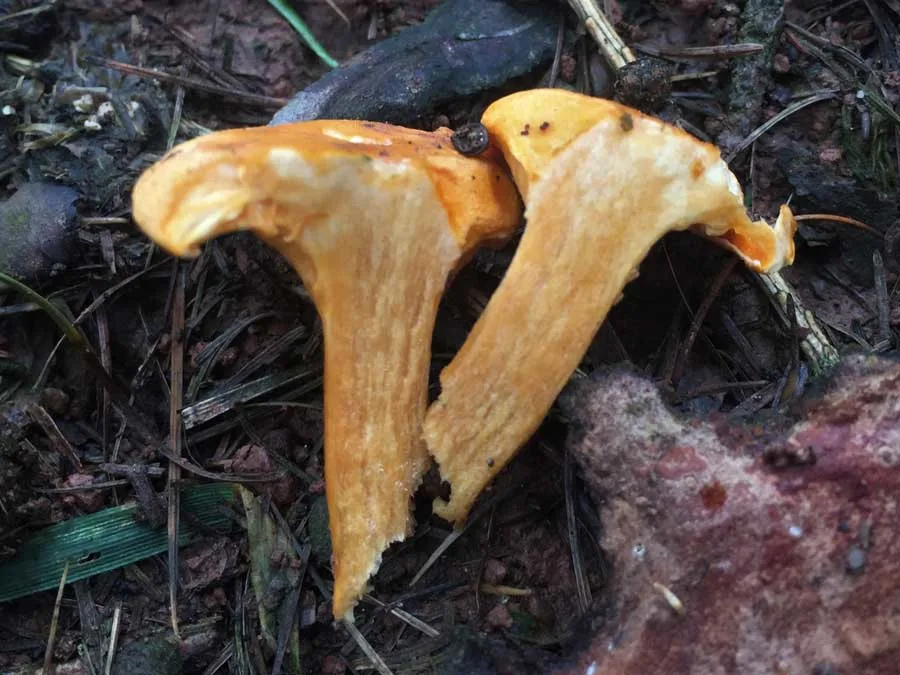
2-6 cm long, 0.3-1 cm diameter. Yellow/orange tapering slightly towards the base, often curved.
Flesh
Pale yellow/orange and tough, never pure white.

Habitat
Mainly coniferous woodland but can be found on heaths and occasionally with deciduous trees.

Possible Confusion
The poisonous Jack O’Lantern (Omphalotus illudens), is a very rare mushroom in Britain, it grows on deciduous wood, it has true gills and is bigger and darker orange in colour.
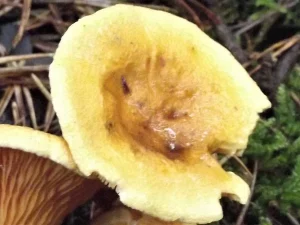
Chanterelle (Cantharellus cibarius), pictured, is a much more yellow colour. It is normally larger and prefers more acidic soil. It has broader mycorrhizal partner range, prefers Beech, Birch, Oak, Spruce and Pine. Its fruity smell is similar to apricot.
Amethyst Chanterelle (Cantharellus amethysteus), has various yellow based colour with a hint of purple to amethyst at the centre. It also prefers acidic soil, fruiting under hardwoods, e.g. Oak, Beech and Birch, but occasionally under conifers, e.g. spruce.
Frosted Chanterelle (Cantherellus pallens), is similar but larger and has a pale yellow cap with a dusting of white, particularly near the middle.
Pale Chanterelle (Cantharellus ferruginascens), looks rather similar to the Frosted Chanterelle, however there is no whitish dust-like cover at centre of its cap. It is one of the rarest amongst the Chanterelles.
Other Facts
The false chanterelle is considered poisonous and may cause serious digestive problems. Among other toxins, it contains high levels of the sugar alcohol arabitol. The mushroom was sometimes described as edible (though not tasty) until 1999. Fries described it as venenatus, meaning “poisonous”, in 1821. Considering the species potentially edible, David Arora speculated that it may have been confused with similar-looking but definitely poisonous species of Omphalotus. Italian mycologist Nicola Sitta has reported that the one attributed case of poisoning he knew of could be attributed to an idiosyncratic reaction as only one of three people eating it got symptoms and concludes that it is harmless. It is eaten in Spain and France, and can legally be sold in France and Belgium. It is not recommended in Italy due to its similarity to poisonous species. It is eaten, though not highly regarded, by the Zapotec people of Ixtlán de Juárez in Oaxaca. The Tepehuán people of northwestern Mexico also occasionally eat the mushroom, which they refer to in their native language as guin’xacan (“delightful”) or kia’s gio’ (“iguana lard”); there, it is commonly prepared by roasting over charcoal, or boiling and garnishing with cheese.