Horn Of Plenty


Occasional but usually found in large groups. They are very hard to spot among the leaf litter until you spot your first one, then if you are lucky, many appear.
Scientific Name – Craterellus cornucopioides


Common Names:
Horn Of Plenty (EN), Black Trumpet (US), Trompette de la mort (FR), Trompette des morts (FR), Corn Llawnder (CY), Lejkowiec Dęty (PL), Sötét Trombitagomba (HU)
Please note that each and every mushroom you come across may vary in appearance to these photos.

Fruiting Body
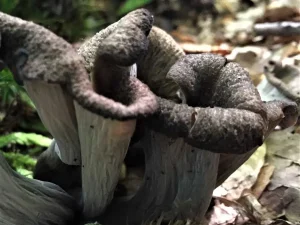
Funnel or trumpet shaped with uneven edges. Black but can be grey, silver or brown.

Gills
Grey / brown to black. Does not really have obvious gills but slight ridges running up the stem to the edge of the cap.

Stem
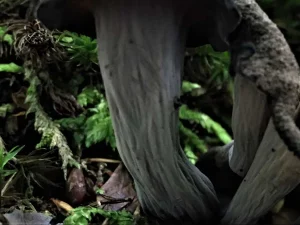
Ash grey to brown. Hollow and hard to tell where the stem stops and the cap begins.
Flesh
Grey/black. Thin and fibrous.

Habitat
Hiding in leaf litter in deciduous woodland usually in clusters with beech.
Possible Confusion
You are unlikely to confuse this species with anything else.
Other Facts
The “horn of plenty,” also known as the cornucopia, is a symbol of abundance and nourishment, often depicted as a large horn-shaped container overflowing with produce, flowers, or nuts.
Historical and Mythological Origins
The term “horn of plenty” originates from classical antiquity, where it symbolizes abundance and nourishment. In Greek mythology, it is associated with the goat Amalthea, who nursed the infant Zeus. According to the myth, Zeus accidentally broke off one of Amalthea’s horns, which then had the divine power to provide endless nourishment. This transformation of the horn into a cornucopia represents the themes of nurturing and the interdependence of life within nature.