Lurid Bolete


This mushroom is edible if well cooked but great caution should be taken in distinguishing it from very similar toxic species, not a mushroom we recommend for the table without a very confident identification.
Scientific Name – Boletus / Suillellus luridus


Common Names:
Lurid Bolete (EN), Cap Tyllog Llwydfelyn (CY), Modroborowik Ponury (PL), Változékony Tinóru (HU)
Please note that each and every mushroom you come across may vary in appearance to these photos.
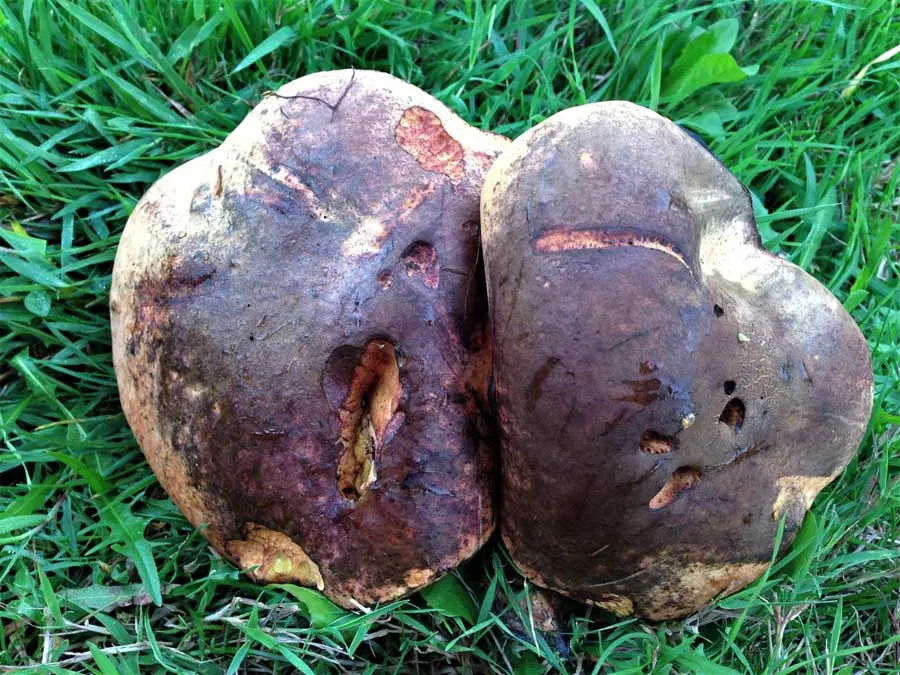
Cap
7-11 cm. There are some variants of the Lurid Bolete, in some the cap starts pale yellow and velvety but soon becomes smooth and stays yellow-brown, in others the cap is dark red-brown with paler flesh where the cap has been damaged. Peach colour or grey-sepia forms are also common.

Pores
Pores starting yellow-orange and becoming deeper red but staying lighter around the edge. The pores bruise easily and stain dark blue to black.

Stem
7-11 cm long, 1-3 cm diameter. The stem is yellow to orange with a dark red mesh which turns to yellow at the very top of the stem. When cut down the middle the stem flushes blue at the top fading to pale orange-yellow at the bottom with a wine red area towards the base.

Flesh
When sliced down the middle the flesh turns from yellow to blue-black instantly but leaves a wine red line between the cap flesh and the top of the pores, there is also usually a wine red region towards the bottom of the sliced stem. This staining fades after a little time. The red line can just be made out in this photo.
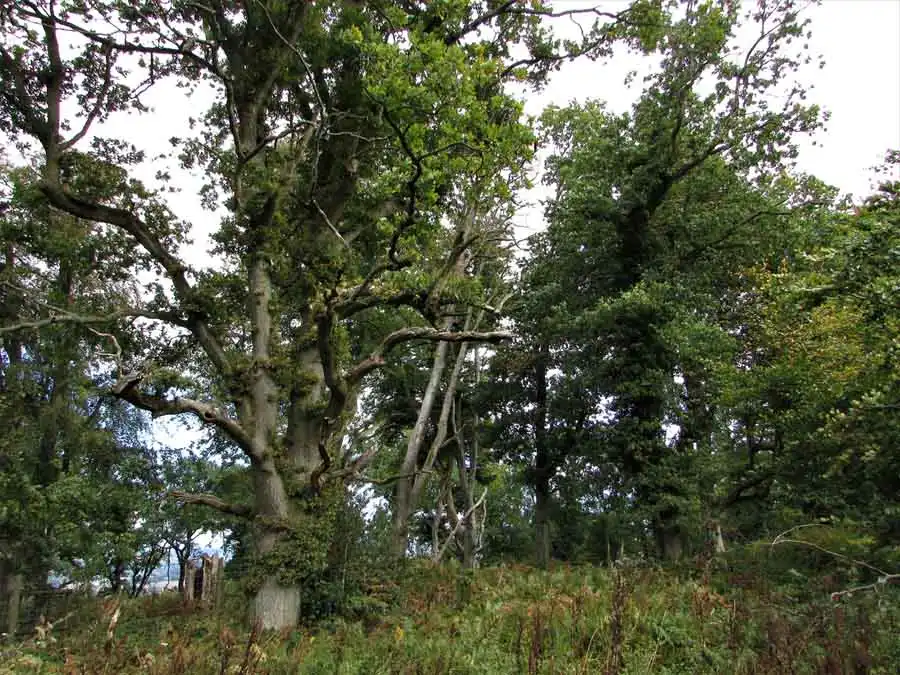
Habitat
Deciduous woodland, particularly Beech and Oak but can sometimes be found in association with conifers.

Possible Confusion
Many toxic species can be confused with the Lurid Bolete:
– The poisonous Oldrose Bolete (Imperator rhodopurpureus) has many similarities with the Lurid Bolete but will never have the red line between pores and cap flesh, it is also very rare;
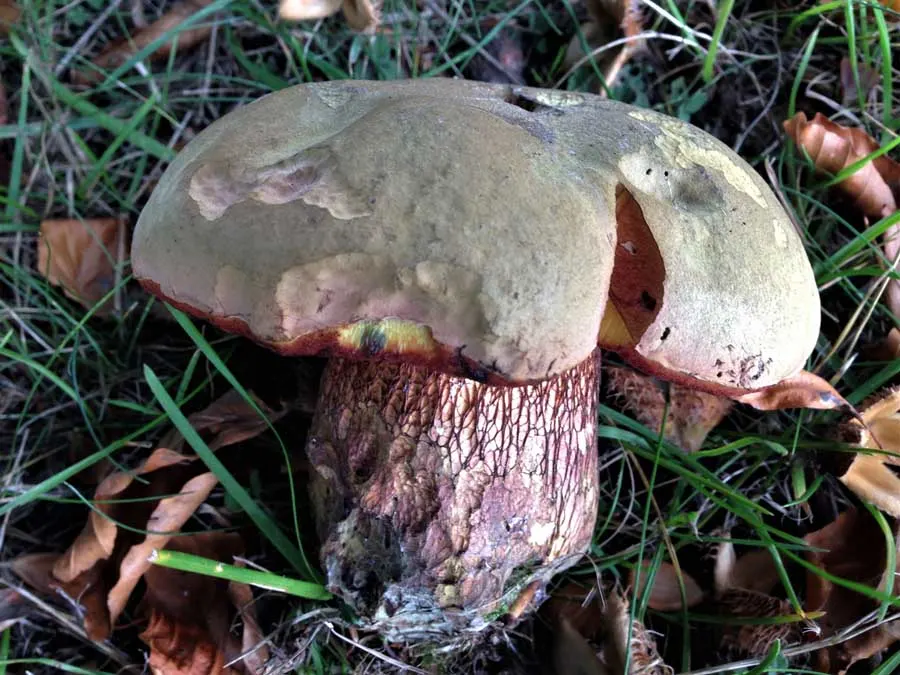
– Devil’s Bolete (Rubroboletus satanas), pictured, is the most toxic possible confusion. It never has the red line that appears between the cap flesh and the top of the pores of the Lurid Bolete, the flesh has a less intense blueing and it won’t have the vinaceous red flesh at the base of stem. The cap of the Devils Bolete is chalky white but this is less reliable as the cap can fade on older Lurid Boletes;
– Bilious Bolete (Rubroboletus legaliae) and Ruddy Bolete (Rubroboletus rhodoxanthus) have similarities with the Devil’s Bolete above and can be distinguished by the same features pointed. In addition to that the Ruddy Bolete’s flesh only turns blue in the cap and upper stem, never down the whole stem;
– The Brawny Bolete (Imperator torosus), the Bitter Beech Bolete (Caloboletus calopus) and the Rooting Bolete (Caloboletus radicans) have yellow pores that turn blue and are never red; While the last two are very bitter and only mildly toxic the first one is quite poisonous.
Edible lookalikes:
– Suillellus mendax is a closely related and extremely similar species, only distinguished by having the mesh pattern restricted to the upper half of the stem and dots in the lower half. It’s equally edible and a harmless confusion;
– Scarletina Bolete (Neoboletus praestigiator) is sometimes confused by beginners, but this has red dots on the whole stem instead of a mesh like pattern.
Chemistry
Several carotenoids are responsible for the various colours of the cap, tubes, and stem, while variegatic and xerocomic acid cause the bluing reaction that occurs with tissue injury.
The composition of the volatile flavour compounds of Suillellus luridus consists largely of linoleic acid, with smaller proportions of 1-butanol, 3-methyl-1-butanol, pentadecanoic acid, palmitic acid, linoleic acid methyl ester, and heptadecanoic acid. Pyrazine compounds might be responsible for the characteristic odour of the dried mushroom. The predominant sterol present in the fruit bodies is ergosterol, with smaller amounts of closely related derivative compounds. The main fatty acids of the mushroom include linoleic acid (53.4% of total fatty acids), oleic acid (24.1%), and palmitic acid (10.2%). Arginine is the free amino acid found in the highest concentration (96.9 μM per gram of dry weight), followed by glutamine (9.7) and alanine (8.2).
The carotenoid content of the fruit bodies differs substantially between the cap, the tubes, and the stem. The upper part of the cap, which contains 3.1 micrograms of carotenoid per gram (μg/g) fresh weight, has predominantly mutatochrome (47% of total carotenoids), 4-keto-α-carotene (40.2%), and δ-carotene (6.4%). The major carotenoids in the tubes (totaling 4.3 μg/g) include neurosporaxanthin (31.1%), auroxanthin (17.2%), 4-keto-α-carotene (17.1%), and rhodopin (15.8%). The stem (1.2 μg/g) contains primarily auroxanthin (32.5%), followed by 4-keto-α-carotene (19.9%), β-zeacarotene (18.5%), and rhodopin (11.4%). The colour change observed with tissue injury is caused by variegatic and xerocomic acids, both of which turn blue when oxidized enzymatically upon exposure to air.