Netted Crust
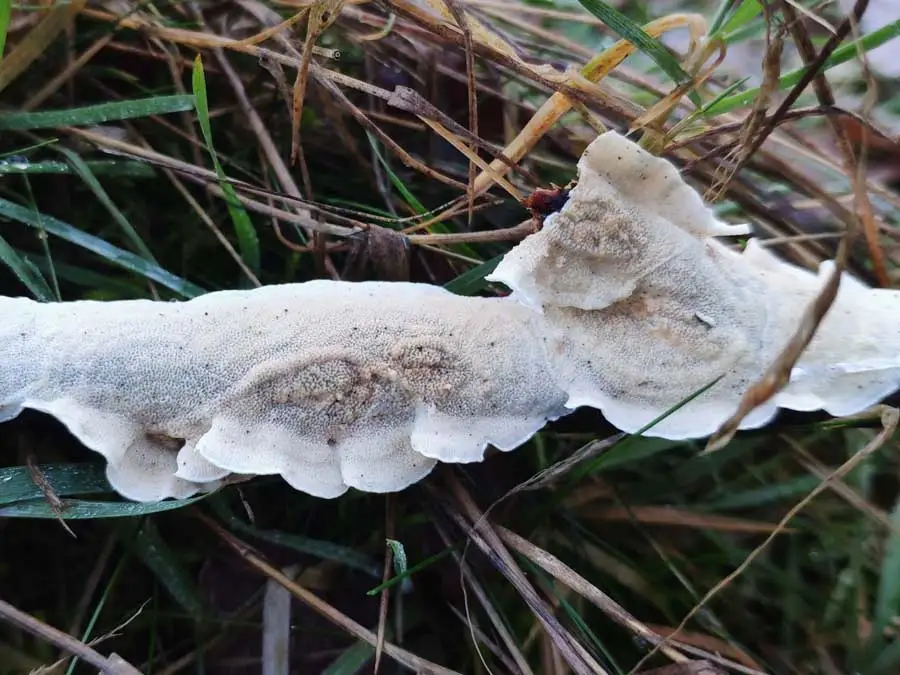


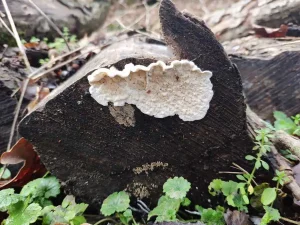
An insignificant looking crust at first, it looks like a thin, white silicon or leathery layer with a wrinkled surface, forming on a fallen branch. Most people probably would never notice it, but once you’ve spotted it, it’s hard to not see it everywhere.
Scientific Name – Byssomerulius corium


Common Names:
Netted Crust, Crawen Ledraidd (CY), Włókniczek Skórkowaty (PL), Bőrszerű Redősgomba (HU)
Please note that each and every mushroom you come across may vary in appearance to these photos.
Fruiting Body
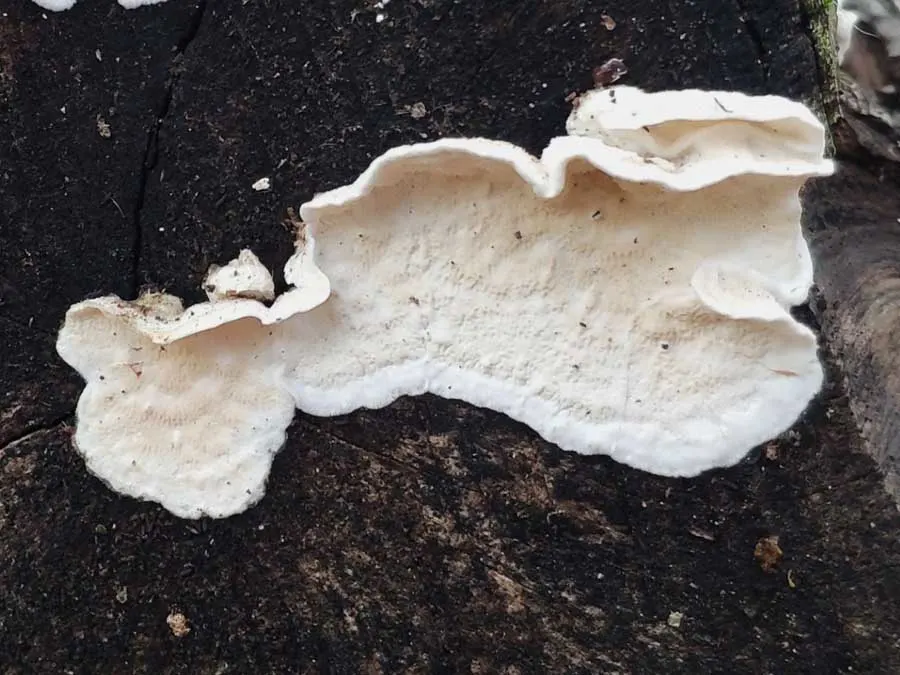
Resupinate to narrowly pileate (the edge of the fruitbody is peeling back). The sterile upper surface is white at first, then might turn somewhat greyish later, or green (if covered with algae), and finely tomentose (densely covered with fine hairs). The fertile lower surface is wrinkled (merulioid), initially white, later yellowish to somewhat dark ochre.
Flesh
Really thin (about 0.5–1mm), leathery, rather tough.
Habitat
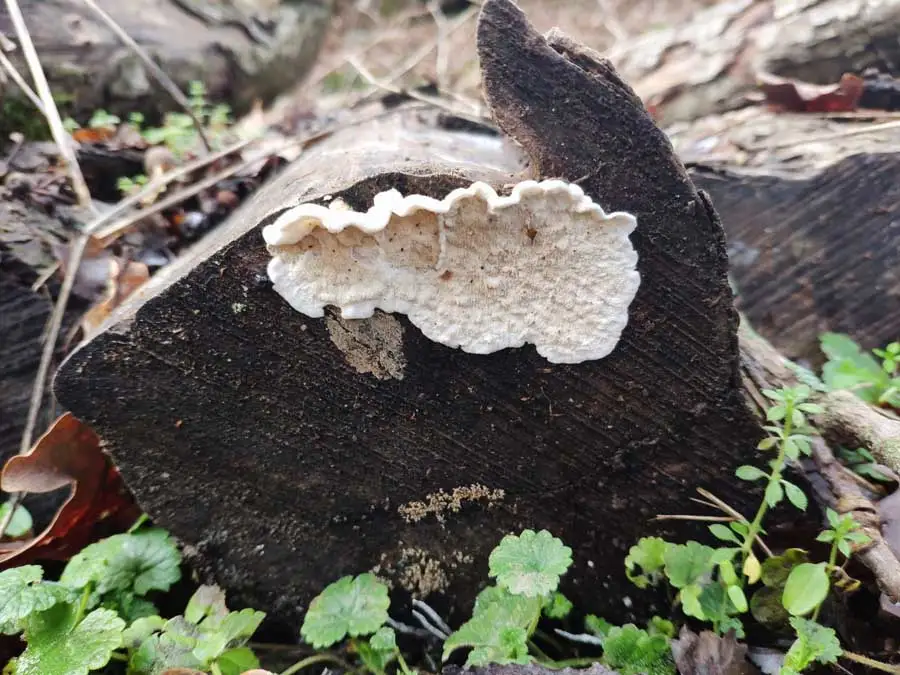
Growing on dead, fallen, or often still attached twigs and branches of deciduous trees, sometimes even on larger logs left on the ground. It can be found the whole year long, but some authors say from Spring to Autumn. Saprotrophic, causes white-rot.
Possible Confusion
Because of its wrinkled (merulioid) fertile surface, it is hard to confuse it with anything.
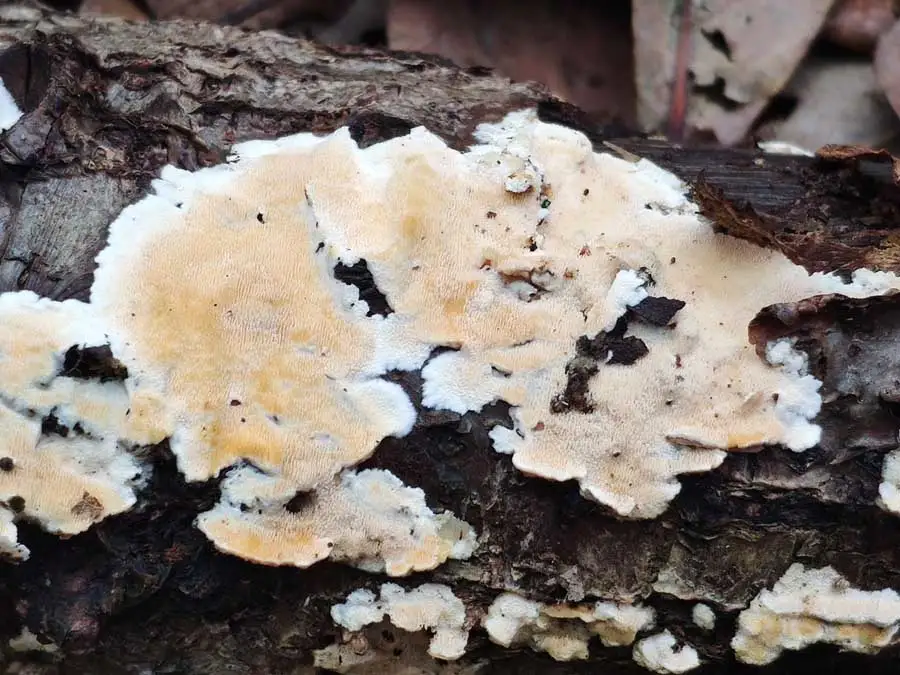
However, when it is young, it might be confused with a young Steccherinum ochraceum (pictured), which has tiny roundish-pointy spines or teeth instead of gills or pores and grows in rather similar habitats as the Netted Crust.
Taste / Smell
Inedible. Taste and smell indistinctive.
Other Facts
The scientific name of the species has an interesting origin. There are two slightly different, but still connected explanations of the origin of the name of the genus, Byssomerulius. Every sources agrees on Byssomerulius is a result of merging two words, ‘Byssos‘ + ‘Merulius‘.
Robert M. Hallock (PhD) in his book, A Mushroom Word Guide : Etymology, PronounciationAild food & Meaning of over 1.500 Words says, the Greek word ‘Byssos’ or ‘Βύσσος’ refers to ‘a fine yellow flax’. Hallock forgot to mention that in Greek, ‘byssos‘ can also mean a fine linen made of byssos-flax, and that linen was also yellowish.
Pat O’Reilly, the author of the book, Fascinated by Fungi, says “the genus name, comes via Greek from the Latin byssus, meaning fine silk-like cloth and is probably a reference to the many fine maze-like ridges that pattern the surface of these fungi rather like interlocking jigsaw pieces, and -merulius is the name (origin obscure) of the closely-related Merulius crust fungus genus.”
We aren’t find the exact etymology of the word ‘Merulius‘, but the word ‘meruloid‘ means: wrinkled with uneven ridges.
The epithet (the 2nd part of the scientific name) ‘corium‘ comes from Latin, and it means ‘leather’.