Silverleaf Fungus
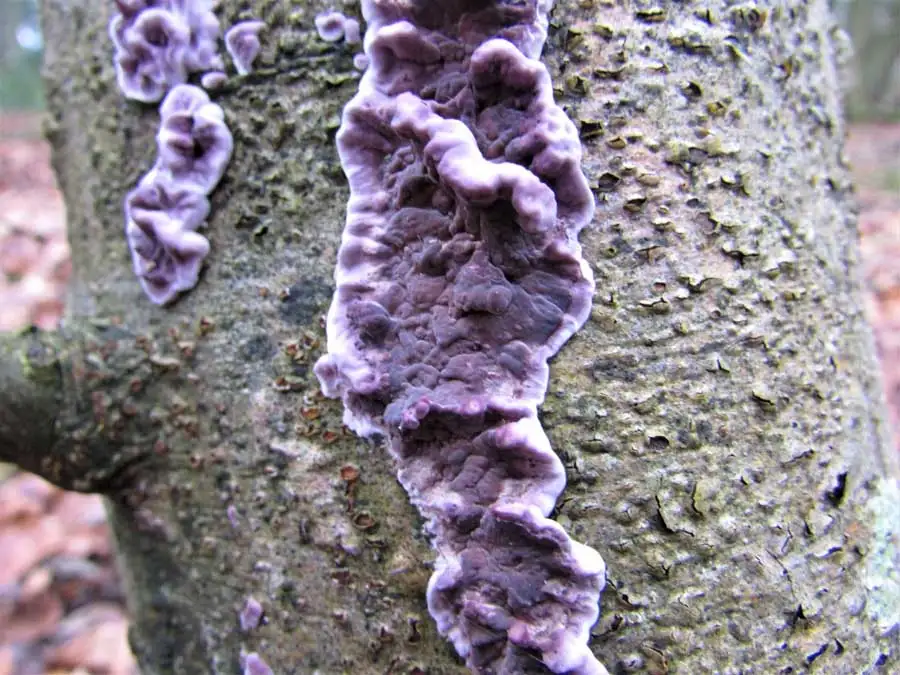


Chondrostereum purpureum is a fungal plant pathogen which causes silver leaf disease of trees. It attacks most species of the rose family Rosaceae, particularly the genus Prunus. The disease is progressive and often fatal. The common name is taken from the progressive silvering of leaves on affected branches.
Scientific Name – Chondrostereum purpureum


Common Names:
Silverleaf Fungus (EN), Ffwng Dail Arian (CY), Chrząstkoskórnik Purpurowy (PL), Lilás Réteggomba (HU)
Please note that each and every mushroom you come across may vary in appearance to these photos.

Fruiting Body
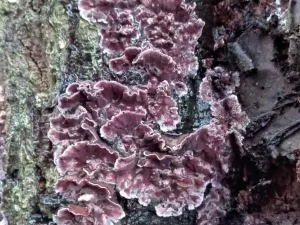
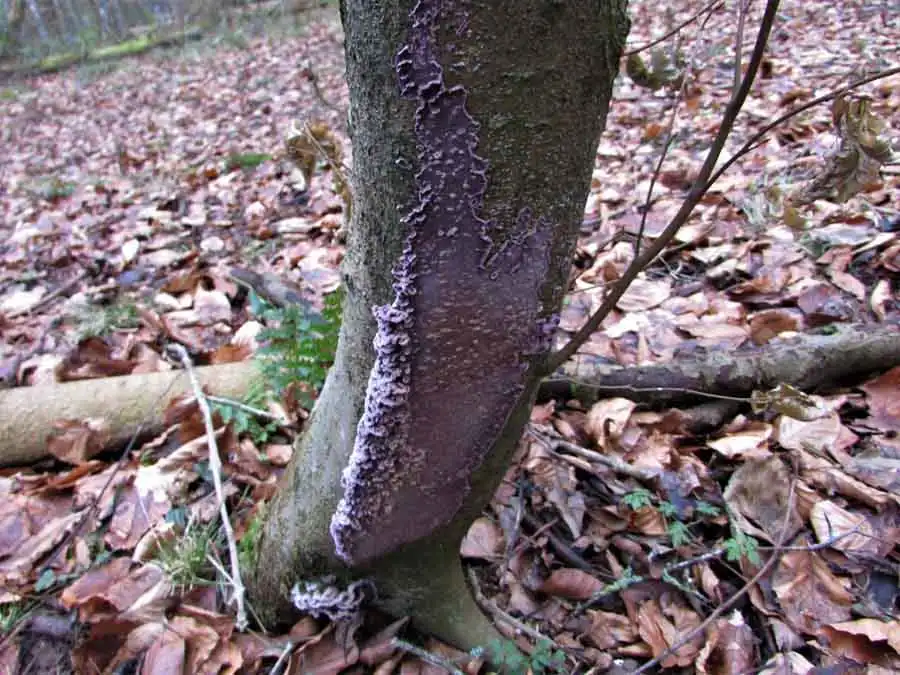
Resupinate (doesn’t form a cap), forms several cm wide irregular patches. If growing on a vertical surface, or the underside of a branch, it might form a rudimentary cap, which can be up to 4 cm wide.
The upper (sterile) surface is more or less hairy (hirsute to tomentose), somewhat brownish in colour.
The fertile surface is uneven, wrinkled, but could be almost completely smooth too. Pinkish to dark purple at first, becoming dark brownish-violet with age. Especially at the early stages of growing, it often secretes dark purple coloured liquid, this is known as guttation.
Flesh
1–2 mm thick; soft and elastic when fresh, tough and brittle when dry. Two layered (duplex), the two layer separated by a black line.
Habitat
On living and dead hardwoods, rarely on conifers. Well-known pathogen (secondary parasite) of members of Rosaceae family, especially different Prunus species, e.g., Plum, Cherry, etc., also of Apple (Malus), Pear (Pyrus), Whitebeam and Rowan (both are Sorbus), causes progressive and often fatal disease, called ‘silver leaf disease’. Saprotrophic on other hardwoods, causes white-rot.
Possible Confusion
It can be confused with other crusts, especially from genus Stereum, when the purple coloured fertile surface of old fruit bodies fade.
Taste / Smell
Inedible. Taste and smell not distinctive.
Other Facts
Silverleaf fungus also used as an effective tool to combat against non-native, invasive broadleaf species in Canada and the US.
The epithet (2nd part of the scientific name which identifies the species within the genus), purpureum, means ‘purple’, and it refers the colour of the young fruit body’s fertile surface.