Hedgehog Fungus


Hedgehog fungus, or Hydnum repandum, is an edible woodland mushroom with distinctive spines under its cap, a nutty flavor, and potential nutritional and medicinal benefits.
Scientific Name – Hydnum repandum


Common Names:
Hedgehog Fungus (EN), Wood Urchin, Wood Hedgehog, Pied-de-mouton (FR), Pigau Draenog y Coed (CY), Kolczak Obłączasty (PL), Sárga Gereben (HU)
Please note that each and every mushroom you come across may vary in appearance to these photos.

Cap
4-8 cm. Convex, can be uneven and even depressed in the middle. Creamy yellow to pale flesh/salmon pink coloured.

Spines
This mushroom has spines, hence the name Hedgehog, which are white to salmon pink, growing up to 6mm long. The spines continue down the stem a short distance (decurrent).

Stem
4-8 cm long, 1.5-3 cm diameter. White, slightly downy where the spines run down the stem. The stem is often not central in the cap.

Flesh
Off-white. Bruising pale yellow especially towards the base.

Habitat
H. repandum is a mycorrhizal fungus. The fruit bodies grow singly, scattered, or in groups on the ground or in leaf litter in both coniferous and deciduous forests. They can also grow in fairy rings. Fruiting occurs from summer to autumn. It is one of the most common of the tooth fungi.
The species is widely distributed in Europe, where, it has been listed as a vulnerable species in the Red Data Lists of the Netherlands, Belgium, and Germany; Sweden lists it as being of Least Concern. The species is found in the Pacific Northwest and Rocky Mountains, and with oaks in eastern North America. It does not occur in Canada, but two related species do: H. washingtonianum and H. subolympicum.
Possible Confusion
The Greenfoot Tooth (Hydnellum scabrosum) is similar but with a dark brown, scaly cap and stem, this mushroom is quite rare and considered by some as poisonous although it is eaten in some countries dried, powdered and used as a pepper like condiment.
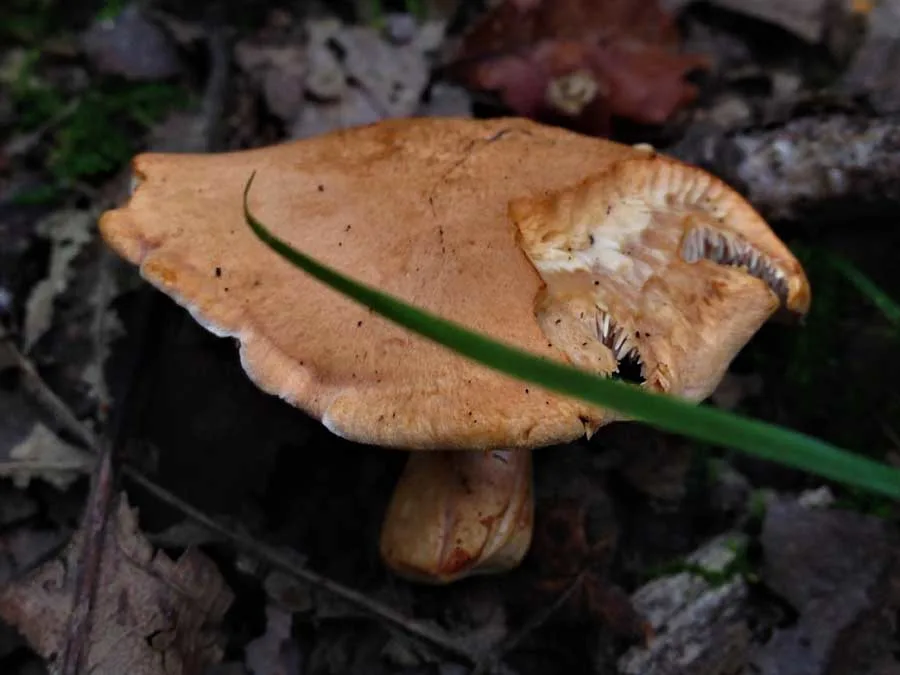
The Terracotta Hedgehog (Hydnum rufescens), pictured, is a smaller, terracotta coloured mushroom from the same family and is edible.
The Jelly Tooth (Pseudohydnum gelatinosum) has spines but is very jelly like in texture and grows from wood and is edible if a little bland.
The Hedgehog Fungus is a very safe mushroom for the novice forager as long as you find a light coloured mushroom growing from the ground with a stem and spines instead of gills it can’t be anything else.
Other Facts
Delicately brushing the cap and stipe of specimens immediately after harvest will help prevent soil from getting lodged between the teeth. H. repandum mushrooms can be cooked by pickling, simmering in milk or stock, and sautéeing, which creates a “tender, meaty texture and a mild flavor.” The mushroom tissue absorbs liquids well and assumes the flavors of added ingredients. The firm texture of the cooked mushroom makes it suitable for freezing. Its natural flavor is reportedly similar to the peppery taste of watercress, or oysters. Older specimens may have a bitter taste, but boiling can remove the bitterness. Specimens found under conifers can taste “unpleasantly strong”. The form amarum, locally common in Slovakia, is reportedly inedible because its fruit body has a bitter taste at all developmental stages.