Scaly Wood Mushroom


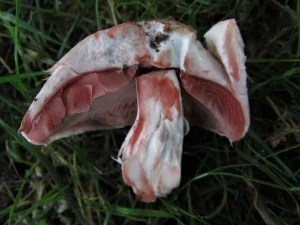
The greyish-brown cap is hemispherical when young, but later flattens out, growing up to 10 centimetres (4 in) in diameter. It is covered with broad scales. The gills are grey when young and become much darker with age. The spores are chocolate brown. The stem is brownish, often with a hanging ring and a small bulb at the base. The flesh is white with a mild taste, turning reddish when cut.
Scientific Name – Agaricus silvaticus



Common Names:
The Great Wood Mushroom, Madarch Cennog y Coed (CY), Pieczarka Krwawiąca (PL), Kárminhúsú Csiperke (HU)

Cap
5-15 cm. Spherical when young becoming convex. Covered in concentric slightly reddish brown scales on a white to pale yellow background.

Gills
Crowded. Free of the stem. Gills starting pink, maturing to dark brown.

Stem
5-10 cm long, 1.5-3 cm diameter. White to pale cream with red hints, smooth above the skirt and covered in small brown scales below.

Skirt
A superior, single white fleshy ring hanging down with brown to grey floccules on the underside.

Flesh
White, bruising or oxidising to pink/red. Can be yellowish in the base of the stem in older specimens.

Habitat
In open mixed woodland.
Possible Confusion
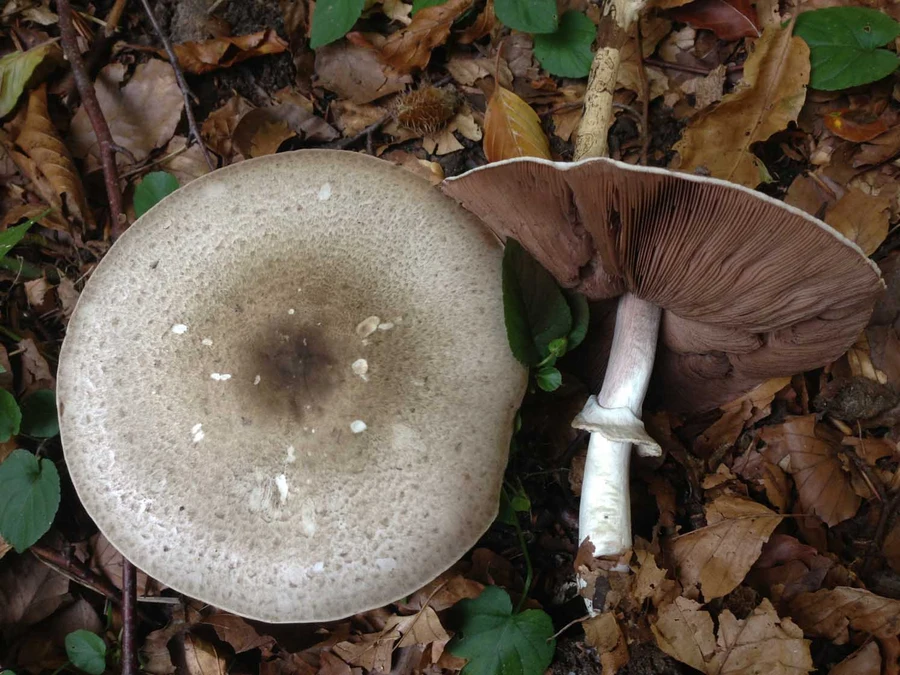
Inky Mushroom (Agaricus moelleri), pictured, looks similar but the chemical, unpleasant smell of the flesh of this toxic mushroom and the fact its flesh doesn’t stain red should keep you safe.
The Prince (Agaricus augustus) is similar but usually a lot larger and delicious so there is no harm confusing the two.
Other Facts
The species name sylvaticus (or silvaticus) means “of the woods”. Both spellings are found in the literature, but Species Fungorum gives sylvaticus as the current name and so that version should be preferred. This well-known species was first validly described under the current name, Agaricus silvaticus, in 1774 by the early mycologist Jacob Christian Schäffer. At that time most gilled mushrooms were all grouped under the genus Agaricus, but later were allocated to new genera which reflected their different characteristics. Now Agaricus has a much more restricted meaning, being the genus of the common cultivated mushrooms of Europe and America, but A. sylvaticus belongs to that group and has kept the same name during all that time.